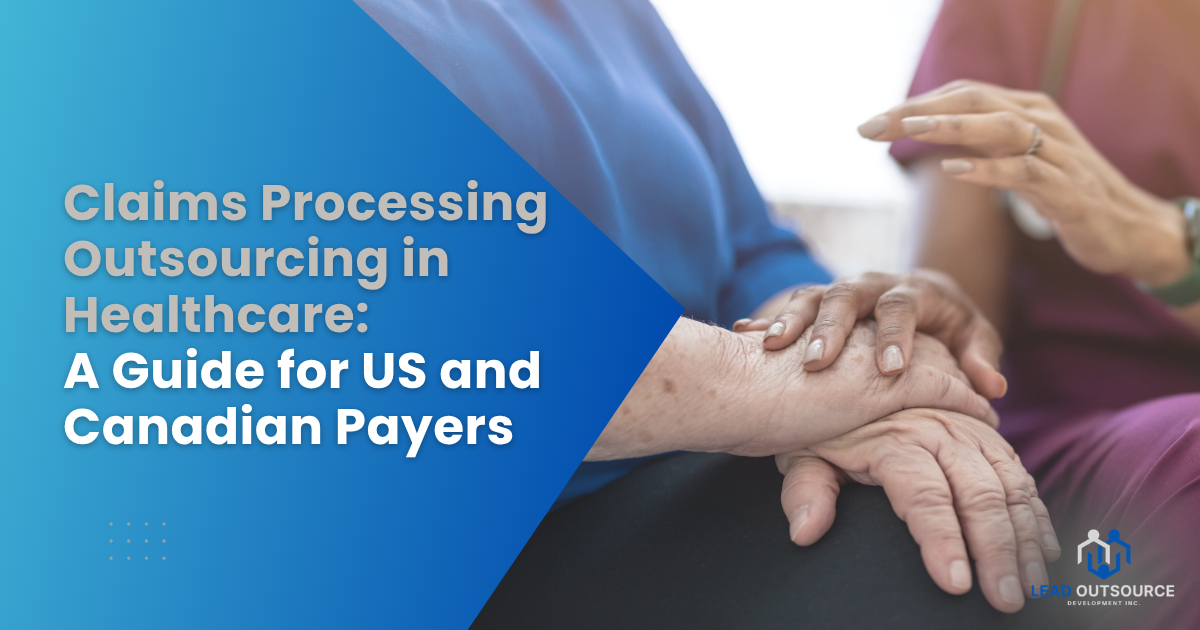
Claims Processing Outsourcing for US & Canadian Healthcare Payers
Claims are the heartbeat of any health insurance operation—and one of its biggest cost centers. Every claim that sits in a queue too long, gets keyed in wrong, or bounces back for missing information costs money, frustrates members and providers, and chips away at trust.
As volumes grow and rules get more complex, more US and Canadian payers are turning to claims processing outsourcing to keep things moving accurately and affordably.
This guide breaks down what claims processing outsourcing involves, where it delivers the most value, the compliance factors you cannot ignore, and how to choose a partner that improves accuracy and turnaround rather than adding risk.
What Is Claims Processing Outsourcing?
Claims processing outsourcing is the practice of delegating part or all of the claims lifecycle—intake, data entry, validation, adjudication support, status communication and follow-up—to a specialised external team. For health payers, it usually sits within broader healthcare outsourcing arrangements and is handled by agents trained specifically in medical claims, coding basics and payer workflows.
The goal is not to remove human judgment from complex decisions. It is to take the high-volume, repetitive, error-prone work off your internal team so adjudicators can focus on the claims that genuinely need expertise.
The Claims Lifecycle—and Where Outsourcing Fits
A typical health claim moves through several stages. Each is a candidate for outsourcing support:
- Intake and registration: Capturing first notice of loss or claim submission, logging it accurately, and acknowledging receipt.
- Data entry and document indexing: Keying claim details, attaching supporting documents and structuring the record.
- Validation and eligibility checks: Confirming coverage, member eligibility and policy terms before adjudication.
- Adjudication support: Preparing claims for decision, flagging exceptions and routing complex cases to internal experts.
- Status communication: Keeping members and providers informed of progress and outcomes.
- Follow-up and resolution: Chasing missing information, handling resubmissions and closing the loop.
Much of this is high-volume back-office work, which is why administrative and back-office services and back-office outsourcing services form the backbone of most claims-processing engagements.
Why Payers Outsource Claims Processing
The benefits go well beyond cost. Done right, outsourcing improves the whole operation:
- Faster turnaround: Dedicated teams and 24/7 coverage clear backlogs and shorten cycle times.
- Lower cost per claim: Offshore processing can cut operational cost dramatically—commonly up to 75%.
- Higher accuracy: Trained specialists plus quality-assurance layers reduce errors and rework.
- Scalability: Absorb enrollment spikes and volume surges without permanent hiring.
- Better member and provider experience: Faster, cleaner claims handling builds trust on both sides.
- Internal focus: Your adjudicators and analysts spend time on complex, high-value decisions instead of data entry.
When claims status drives a lot of inbound contact, pairing processing with inbound call center services or a dedicated medical call center keeps members and providers informed and reduces repeat calls.
Accuracy and Quality: Where Good Partners Earn Their Keep
In claims, accuracy is everything. A single miskeyed code or missed eligibility check can trigger a denial, an appeal, a complaint and a costly rework cycle. Strong claims-processing partners build quality in through:
- Multi-level quality-assurance checks before claims advance
- Agents trained in medical terminology and claims workflows
- Clear exception-handling rules and escalation paths
- Performance dashboards tracking accuracy, turnaround and rework rates
- Continuous feedback loops between the BPO team and your adjudicators
Ask any prospective partner to show you their QA framework and their accuracy metrics. The best providers are proud of these numbers.
Compliance and Data Security in Claims Outsourcing
Claims contain protected health information, so the same regulatory standards that govern insurance outsourcing apply here—and arguably more so, given the clinical detail involved. Confirm your partner provides:
- HIPAA-compliant handling and signed business associate agreements (US)
- Alignment with PIPEDA and provincial health-privacy laws (Canada)
- Secure, access-controlled processing environments
- Documented breach-notification and incident-response procedures
- Ongoing agent training on PHI handling and confidentiality
If a provider treats compliance as a checkbox rather than a discipline, walk away. The cost of a data breach dwarfs any processing savings.
Technology and Automation in Modern Claims Processing
Leading providers combine skilled people with modern tooling to push accuracy and speed even higher. Expect to see:
- Workflow and case-management platforms
- OCR and automated document capture
- Rules engines that flag exceptions automatically
- Integration with your existing claims and policy systems
- AI-assisted validation that supports—rather than replaces—human review
- Analytics dashboards for real-time visibility
Where these systems need to stay reliable and connected, outsourced IT support services can keep the technical environment running smoothly.
How to Choose a Claims Processing Partner
Use the same rigor you would for any critical operation:
- Proven claims experience: Specifically in health insurance, not generic data entry.
- Documented accuracy and SLA performance: Real numbers, not promises.
- Compliance and security: HIPAA, PIPEDA and audited controls built in.
- Scalability: Capacity to flex with enrollment and seasonal volume.
- Integration capability: Ability to work within your systems and workflows.
- Transparent reporting: Dashboards and regular reviews so you always know where claims stand.
And as with any outsourcing decision, start with a focused pilot on a defined claim type or stage before scaling up.
Frequently Asked Questions
What parts of claims processing can be outsourced?
Intake, data entry, document indexing, eligibility and validation checks, adjudication support, status communication and follow-up can all be outsourced. Final decisions on complex claims typically stay with your internal experts.
Is outsourced claims processing accurate?
With trained specialists and multi-level quality assurance, a strong partner often matches or exceeds in-house accuracy while improving turnaround. Ask to see their QA framework and metrics.
How does claims outsourcing stay HIPAA-compliant?
Through signed business associate agreements, secure access-controlled environments, documented breach procedures and ongoing agent training on handling protected health information.
How much can payers save by outsourcing claims processing?
Savings depend on volume and location, but offshore claims processing commonly reduces operational cost by up to 75% versus in-house teams.
Final Thoughts
Claims processing outsourcing gives US and Canadian payers a way to process more claims, faster, more accurately and at a lower cost—without sacrificing compliance or control. By delegating high-volume, repetitive stages of the claims lifecycle to a specialised, compliant partner, insurers free their internal experts to focus on the decisions that matter most. The result is shorter cycle times, fewer errors, happier members and providers, and a healthier bottom line.
Process Claims Faster, More Accurately, for Less
Lead Outsource Development Inc. helps US and Canadian healthcare payers, TPAs and insurers build dedicated, HIPAA-aware claims processing teams—improving accuracy and turnaround while cutting operational costs by up to 75%.
Book a free strategy call or contact Lead Outsource Development Inc. to design a low-risk claims pilot. Prefer to talk now? Call +1 (949) 216-8151.
 Top 10 U.S. States Outsourcing to the Philippines in 2026 (and Why They Choose It)
 Call Center for Healthcare in Bacolod, Philippines
Related Posts
About the Author: Lead Outsource Development Inc.

- What Is Claims Processing Outsourcing?
- The Claims Lifecycle—and Where Outsourcing Fits
- Why Payers Outsource Claims Processing
- Accuracy and Quality: Where Good Partners Earn Their Keep
- Compliance and Data Security in Claims Outsourcing
- Technology and Automation in Modern Claims Processing
- How to Choose a Claims Processing Partner
- Frequently Asked Questions
- Final Thoughts